All posts by jennica javier

Rights of Redemption and Repurchasing Foreclosed Properties

[feather/share]

In the Philippine legal landscape, foreclosure does not immediately divest a property owner of all rights. Central to the protection of debtors is the Right of Redemption—the legal privilege granted to a mortgagor to reacquire their property after it has been sold at public auction to satisfy a debt.

Understanding the nuances of redemption requires distinguishing between the two primary types of foreclosure: Judicial and Extrajudicial.


1. Types of Redemption

There are two distinct stages and types of redemption recognized under Philippine law:

Equity of Redemption

This applies primarily to Judicial Foreclosures (governed by Rule 68 of the Rules of Court). It is the right of the defendant-mortgagor to extinguish the mortgage and retain ownership of the property by paying the full amount of the debt, including interest and costs, after the court renders judgment but before the sale is confirmed by the court.

  • Period: Usually not less than 90 days nor more than 120 days from the entry of judgment.
  • Effect: Once the sale is confirmed by the court, the equity of redemption is generally extinguished (except in cases involving banking institutions).

Right of Redemption (Legal Redemption)

This applies to Extrajudicial Foreclosures (governed by Act No. 3135). This is the right of the mortgagor to repurchase the property after the auction sale has taken place.

  • Period: Generally one (1) year from the date of the registration of the Certificate of Sale with the Register of Deeds.

2. Redemption Periods and the “General Banking Law”

While Act No. 3135 provides a one-year redemption period, the General Banking Law of 2000 (Republic Act No. 8791) introduced a significant exception for juridical persons (corporations) when the mortgagee is a bank.

Mortgagor Type Mortgagee Redemption Period
Natural Person (Individual) Bank or Individual One (1) year from registration of sale.
Juridical Person (Corporation) Individual/Non-Bank One (1) year from registration of sale.
Juridical Person (Corporation) Bank Until, but not after, the registration of the certificate of foreclosure sale, or three (3) months after the foreclosure, whichever is earlier.

Note: For corporations dealing with banks, the window is significantly shorter, often effectively ending once the certificate of sale is registered.


3. Redemption Price: How Much to Pay?

To validly exercise the right of redemption, the mortgagor must tender the correct amount. Under the Rules of Court and the General Banking Law, this includes:

  1. The purchase price paid at the auction.
  2. Interest on the purchase price (usually 1% per month, or as stipulated).
  3. Any assessments or taxes paid by the purchaser after the sale.
  4. Interest on those assessments/taxes.
  5. In the case of banks, all costs and expenses incurred by the bank for the custody and preservation of the property.

4. Procedure for Exercising the Right

To successfully repurchase the property, the following steps must be observed:

  1. Written Offer: The redemptioner should make a formal written offer to the purchaser or the Sheriff who conducted the sale.
  2. Tender of Payment: Actual payment must be made within the redemption period. If the purchaser refuses the payment, the redemptioner must perform a Consignation—depositing the money with the court to freeze the period and preserve the right.
  3. Certificate of Redemption: Upon payment, a Certificate of Redemption is issued and must be filed with the Register of Deeds to cancel the Certificate of Sale.

5. Right of Possession During Redemption

During the one-year redemption period (in extrajudicial cases), the mortgagor generally remains in possession of the property. However, the purchaser may petition the court for a Writ of Possession even before the period expires, provided they post a bond. The bond is intended to indemnify the mortgagor if it is later discovered that the foreclosure was not justified.

Once the redemption period expires and no redemption is made, the right to possess becomes absolute for the purchaser, and the mortgagor can be evicted via an ex parte motion for a writ of possession.


6. Who May Redeem?

The right is not exclusive to the original owner. It extends to:

  • The mortgagor or their successors-in-interest (heirs or assignees).
  • A creditor having a lien by attachment, judgment, or mortgage on the property subsequent to the mortgage under which the property was sold (often called “Redemptioners”).

7. Consequences of Non-Redemption

If the mortgagor fails to redeem within the prescribed period:

  • The purchaser’s right to the property becomes absolute.
  • Consolidation of Title: The purchaser executes an Affidavit of Consolidation, and the Register of Deeds cancels the old title (TCT) in the name of the mortgagor and issues a new title in the name of the purchaser.
  • The mortgagor loses all legal claims to the property.
Leave a comment

Rights of Redemption and Repurchasing Foreclosed Properties

[feather/share]

In the Philippine legal landscape, foreclosure does not immediately divest a property owner of all rights. Central to the protection of debtors is the Right of Redemption—the legal privilege granted to a mortgagor to reacquire their property after it has been sold at public auction to satisfy a debt.

Understanding the nuances of redemption requires distinguishing between the two primary types of foreclosure: Judicial and Extrajudicial.


1. Types of Redemption

There are two distinct stages and types of redemption recognized under Philippine law:

Equity of Redemption

This applies primarily to Judicial Foreclosures (governed by Rule 68 of the Rules of Court). It is the right of the defendant-mortgagor to extinguish the mortgage and retain ownership of the property by paying the full amount of the debt, including interest and costs, after the court renders judgment but before the sale is confirmed by the court.

  • Period: Usually not less than 90 days nor more than 120 days from the entry of judgment.
  • Effect: Once the sale is confirmed by the court, the equity of redemption is generally extinguished (except in cases involving banking institutions).

Right of Redemption (Legal Redemption)

This applies to Extrajudicial Foreclosures (governed by Act No. 3135). This is the right of the mortgagor to repurchase the property after the auction sale has taken place.

  • Period: Generally one (1) year from the date of the registration of the Certificate of Sale with the Register of Deeds.

2. Redemption Periods and the “General Banking Law”

While Act No. 3135 provides a one-year redemption period, the General Banking Law of 2000 (Republic Act No. 8791) introduced a significant exception for juridical persons (corporations) when the mortgagee is a bank.

Mortgagor Type Mortgagee Redemption Period
Natural Person (Individual) Bank or Individual One (1) year from registration of sale.
Juridical Person (Corporation) Individual/Non-Bank One (1) year from registration of sale.
Juridical Person (Corporation) Bank Until, but not after, the registration of the certificate of foreclosure sale, or three (3) months after the foreclosure, whichever is earlier.

Note: For corporations dealing with banks, the window is significantly shorter, often effectively ending once the certificate of sale is registered.


3. Redemption Price: How Much to Pay?

To validly exercise the right of redemption, the mortgagor must tender the correct amount. Under the Rules of Court and the General Banking Law, this includes:

  1. The purchase price paid at the auction.
  2. Interest on the purchase price (usually 1% per month, or as stipulated).
  3. Any assessments or taxes paid by the purchaser after the sale.
  4. Interest on those assessments/taxes.
  5. In the case of banks, all costs and expenses incurred by the bank for the custody and preservation of the property.

4. Procedure for Exercising the Right

To successfully repurchase the property, the following steps must be observed:

  1. Written Offer: The redemptioner should make a formal written offer to the purchaser or the Sheriff who conducted the sale.
  2. Tender of Payment: Actual payment must be made within the redemption period. If the purchaser refuses the payment, the redemptioner must perform a Consignation—depositing the money with the court to freeze the period and preserve the right.
  3. Certificate of Redemption: Upon payment, a Certificate of Redemption is issued and must be filed with the Register of Deeds to cancel the Certificate of Sale.

5. Right of Possession During Redemption

During the one-year redemption period (in extrajudicial cases), the mortgagor generally remains in possession of the property. However, the purchaser may petition the court for a Writ of Possession even before the period expires, provided they post a bond. The bond is intended to indemnify the mortgagor if it is later discovered that the foreclosure was not justified.

Once the redemption period expires and no redemption is made, the right to possess becomes absolute for the purchaser, and the mortgagor can be evicted via an ex parte motion for a writ of possession.


6. Who May Redeem?

The right is not exclusive to the original owner. It extends to:

  • The mortgagor or their successors-in-interest (heirs or assignees).
  • A creditor having a lien by attachment, judgment, or mortgage on the property subsequent to the mortgage under which the property was sold (often called “Redemptioners”).

7. Consequences of Non-Redemption

If the mortgagor fails to redeem within the prescribed period:

  • The purchaser’s right to the property becomes absolute.
  • Consolidation of Title: The purchaser executes an Affidavit of Consolidation, and the Register of Deeds cancels the old title (TCT) in the name of the mortgagor and issues a new title in the name of the purchaser.
  • The mortgagor loses all legal claims to the property.


Leave a comment

Defective Contracts | Contracts | OBLIGATIONS AND CONTRACTS

[feather/share]

Under Philippine civil law, contracts can become defective in various ways, potentially invalidating them or limiting their enforceability. Defective contracts are addressed in Book IV, Title II, Chapter 7 of the Civil Code of the Philippines. A contract’s defectiveness can arise due to issues with its validity, consent, object, cause, or form. Defective contracts are primarily categorized as (1) Rescissible Contracts(2) Voidable Contracts(3) Unenforceable Contracts, and (4) Void or Inexistent Contracts. Each type has distinct features, grounds, and effects, which are as follows:

1. Rescissible Contracts

Rescissible contracts are initially valid and binding, but they may be rescinded, or canceled, due to certain external factors that prejudice the rights of a party or a third person. Articles 1380–1389 of the Civil Code govern these contracts.

Grounds for Rescission

A contract may be rescinded on the following grounds:

  • Contracts entered into by guardians where the ward suffers a lesion (injury) exceeding one-fourth of the value of the objects in the contract (Art. 1381).
  • Contracts by representatives in cases where the person represented suffers a lesion exceeding one-fourth of the value (Art. 1381).
  • Contracts made in fraud of creditors when the latter cannot otherwise collect the claims (Art. 1381).
  • Contracts concerning things under litigation that are entered into without court approval (Art. 1381).
  • Other cases specifically provided by law (Art. 1381).

Effects and Conditions of Rescission

  • Rescission does not apply to cases where the party seeking rescission has no other legal remedy to protect their interest (Art. 1383).
  • The action for rescission must be brought within four years (Art. 1389).
  • Rescission is limited to the extent of the damage caused, making it a partial relief (Art. 1384).

2. Voidable Contracts

Voidable contracts are valid until they are annulled. These contracts contain vitiated consent, meaning the consent of one of the parties was affected by mistake, violence, intimidation, undue influence, or fraud (Articles 1390–1402).

Grounds for Annulment

A contract is voidable if:

  • One party was incapacitated to give consent (e.g., minor or mentally incapacitated) (Art. 1390).
  • Consent was vitiated by mistake, violence, intimidation, undue influence, or fraud (Art. 1390).

Effects and Conditions for Annulment

  • A voidable contract is binding until annulled by a court.
  • The action to annul based on incapacity or vitiated consent must be filed within four years (Art. 1391).
  • If annulled, parties must return what they have received under the contract (Art. 1398).
  • Ratification can validate a voidable contract, extinguishing the grounds for annulment (Art. 1392–1396).

3. Unenforceable Contracts

Unenforceable contracts are agreements that cannot be enforced by action in court unless they are ratified. These are covered under Articles 1403–1408.

Types of Unenforceable Contracts

  • Contracts entered into without authority or exceeding the authority of the agent.
  • Contracts that do not comply with the Statute of Frauds (Art. 1403).
  • Contracts where both parties are incapable of giving consent (Art. 1403).

Effects and Ratification of Unenforceable Contracts

  • They are unenforceable in court unless ratified.
  • Ratification makes the contract enforceable (Art. 1405).
  • In pari delicto rule applies, meaning neither party can sue the other if both are at fault (Art. 1406).

4. Void or Inexistent Contracts

Void contracts have no effect from the beginning and cannot be ratified. Articles 1409–1422 discuss void contracts.

Grounds for Void Contracts

A contract is void if it:

  • Lacks an essential requisite (e.g., consent, object, or cause) (Art. 1318).
  • Is contrary to law, morals, good customs, public order, or public policy (Art. 1409).
  • Is simulated, meaning the parties do not intend the contract to be legally binding (Art. 1345–1346).
  • Involves impossible or unlawful objects (Art. 1409).
  • Is expressly prohibited or declared void by law (Art. 1409).

Effects of Void Contracts

  • A void contract produces no legal effect (Art. 1409).
  • Parties to a void contract cannot compel performance or seek damages.
  • If the contract involves illegal cause or object, and both parties are at fault (in pari delicto), neither party can recover what they have given under the contract (Art. 1411).
  • Exceptions exist where public interest is involved, allowing innocent parties to recover under certain circumstances (Art. 1412).

Special Rules for Void Contracts Involving Immoral Considerations

  • Contracts involving acts against public policy or that encourage illegal activities are void.
  • Recovery is permitted under certain exceptions, such as when public interest or the innocent party is at risk (Art. 1414–1422).

Summary and Practical Implications

In practice, understanding the classification of a defective contract is crucial as it affects how one may contest or enforce the contract. Key differences between these defective contracts are based on their validity, the possibility of ratification, the need for annulment or rescission, and the enforceability of obligations arising from the agreement.

Leave a comment

PRESIDENTIAL DECREE NO. 957

[feather/share]

PD 957 is titled the “Subdivision and Condominium Buyers’ Protective Decree.” It aims to protect subdivision and condominium buyers by regulating sales and requiring developers/sellers to provide and maintain basic subdivision/construction requirements, deliver titles free from liens/encumbrances, and prevent fraudulent practices and double sales.

Yes. “Sale” includes every disposition or attempt to dispose for valuable consideration, and expressly includes contracts to sell, contracts of purchase and sale, exchange, option of sale/purchase, solicitation, offer to sell, and even privilege/certificate of receipt in cooperatives/corporations that gives the right to participate in or acquire land.

The National Housing Authority (Authority) has exclusive jurisdiction to regulate the real estate trade and business in accordance with PD 957.

The owner/dealer must (1) register the project with the Authority, obtain a registration certificate after publication requirements, and then (2) obtain a license to sell from the Authority before selling.

A copy of the approved subdivision/condominium plan; a copy of any circular/prospectus/brochure/advertisement/letter for public offering; for business firms, a balance sheet and corporate/partnership documents with amendments and by-laws; and a title to the property free from liens and encumbrances (with a permitted mortgage stipulation allowing release per unit/lot upon full payment).

The Authority requires publication of a notice of filing the registration statement in two newspapers of general circulation (one English, one Pilipino) once a week for two consecutive weeks, at the applicant’s expense. The project is deemed registered upon completion of the publication requirement.

The Authority must be convinced that the owner/dealer is of good repute, financially stable, and that the proposed sales to the public would not be fraudulent.

No license to sell is issued without an adequate performance bond approved by the Authority. It guarantees construction and maintenance of roads, gutters, drainage, sewerage, water systems, lighting systems, full development of the project, and compliance with applicable laws/rules.

Exempt transactions include: (1) sale resulting from partition among co-owners/co-heirs; (2) sale/transfer by the original purchaser and subsequent sale of the same lot; and (3) sale by or for account of a mortgagee in ordinary course when necessary to liquidate a bona fide debt.

Upon verified complaint by a buyer or interested party, the Authority may immediately suspend pending investigation/hearing. It may also motu proprio suspend if information in the registration statement is misleading/incorrect/inadequate/incomplete or if the offering may tend to work a fraud upon prospective buyers.

After examination/hearing (Sections 13 and 14 procedures), revocation may occur if there is evidence that the owner/dealer is insolvent; violated PD 957 or rules/undertakings; engaged/is about to engage in fraudulent transactions; made misrepresentations in sale literature; is of bad business repute; or does not conduct business according to law/sound business principles.

If the Authority appears that a person is engaged or about to engage in acts constituting or leading to violations, it may issue a cease and desist order to enjoin such acts, after due notice and hearing per the hearing procedure.

No installment payment by a buyer may be forfeited if the buyer, after due notice, desists due to the owner/developer’s failure to develop according to approved plans within the time limit. The buyer may opt for reimbursement of total amount paid plus amortization interests (excluding delinquency interests) at legal rate.

The owner/developer must deliver the title upon full payment. No fee except those required for registration of the deed of sale may be collected for title issuance. If a mortgage remains outstanding at issuance, the owner/developer must redeem the mortgage portion within six months so the fully paid buyer gets title secured and delivered.

Real estate tax and assessment are paid by the owner/developer without recourse to the buyer as long as title has not passed. If the buyer actually takes possession and occupies, the buyer becomes liable for such tax/assessment effective the year following that taking.

Any stipulation or condition where a person waives compliance with PD 957 or rules issued pursuant thereto is void (nullity of waivers).

Upon conviction, violations may be punished by fine not exceeding P20,000 and/or imprisonment not exceeding ten years. For corporations/partnerships/cooperatives/associations, the President/Manager/Administrator or person in charge of administration shall be criminally responsible.

The Authority may examine business affairs and condition of entities engaged in selling, administer oaths, subpoena witnesses and documents, authorize ocular inspections through engineers, and inspect books/papers/letters and other documents.

No owner/developer may change or alter roads, open spaces, infrastructures/facilities for public use or other subdivision development elements in the approved plan and/or represented in advertisements without Authority permission and written conformity/consent of the homeowners association; or if absent, consent of the majority of buyers.

Leave a comment

Reverse Annuity Mortgage (RAM)

Facebooktwitterredditpinterestlinkedinmail

A Reverse Annuity Mortgage (RAM) is a type of loan designed for homeowners, typically seniors, that allows them to convert a portion of their home equity into cash. Instead of making monthly payments to a lender, the lender pays the homeowner a fixed amount, which can be received as a lump sum, monthly payments or as a line of credit. RAM features include:

  1. No Monthly Payments: Borrowers do not have to make monthly mortgage payments; the loan balance increases over time as interest accumulates.
  2. Home Equity Access: It provides access to cash without the need to sell the home.
  3. Repayment: The loan is typically repaid when the homeowner sells the home, moves out or passes away. The home is then sold, and the proceeds go to repay the loan, with any remaining equity going to the homeowner’s estate.
  4. Age Requirement: Borrowers usually need to be at least 62 years old.
  5. Homeownership Retention: Homeowners retain the title and continue to live in the home as long as they comply with the loan terms.

It’s important for homeowners to carefully consider the implications, as using a RAM can affect estate planning and the inheritance of heirs.

Leave a comment

THE CONDOMINIUM ACT OF THE PHILIPPINES | R.A. NO. 4726

[feather/share]

AN ACT TO DEFINE CONDOMINIUM, ESTABLISH REQUIREMENTS FOR ITS CREATION, AND                                                            GOVERN ITS INCIDENTS.
The short title of this Act shall be “The Condominium Act”.

. A condominium is an interest in real property consisting of separate interest in a unit in a residential, industrial or commercial building and an undivided interest in common, directly or indirectly, in the land on which it is located and in other common areas of the building. A condominium may include, in addition, a separate interest in other portions of such real property. Title to the common areas, including the land, or the appurtenant interests in such areas, may be held by a corporation specially formed for the purpose (hereinafter known as the “condominium corporation”) in which the holders of separate interest shall automatically be members or shareholders, to the exclusion of others, in proportion to the appurtenant interest of their respective units in the common areas.

The real right in condominium may be ownership or any other interest in real property recognized by law, on property in the Civil Code and other pertinent laws.

As used in this Act, unless the context otherwise requires:


(a) “Condominium” means a condominium as defined in the next preceding section.

(b) “Unit” means a part of the condominium project intended for any type of independent use or ownership, including one or more rooms or spaces located in one or more floors (or part or parts of floors) in a building or buildings and such accessories as may be appended thereto.

(c) “Project” means the entire parcel of real property divided or to be divided in condominiums, including all structures thereon,

(d) “Common areas” means the entire project excepting all units separately granted or held or reserved.

(e) “To divide” real property means to divide the ownership thereof or other interest therein by conveying one or more condominiums therein but less than the whole thereof.

The provisions of this Act shall apply to property divided or to be divided into condominiums only if there shall be recorded in the Register of Deeds of the province or city in which the property lies and duly annotated in the corresponding certificate of title of the land, if the latter had been patented or registered under either the Land Registration or Cadastral Acts, an enabling or master deed which shall contain, among others, the following:


(a) Description of the land on which the building or buildings and improvements are or are to be located;

(b) Description of the building or buildings, stating the number of stories and basements, the number of units and their accessories, if any;

(c) Description of the common areas and facilities;

(d) A statement of the exact nature of the interest acquired or to be acquired by the purchaser in the separate units and in the common areas of the condominium project. Where title to or the appurtenant interests in the common areas is or is to be held by a condominium corporation, a statement to this effect shall be included;

(e) Statement of the purposes for which the building or buildings and each of the units are intended or restricted as to use;

(f) A certificate of the registered owner of the property, if he is other than those executing the master deed, as well as of all registered holders of any lien or encumbrance on the property, that they consent to the registration of the deed


Any transfer or conveyance of a unit or an apartment, office or store or other space therein, shall include the transfer or conveyance of the undivided interests in the common areas or, in a proper case, the membership or shareholdings in the condominium corporation: Providedhowever, That where the common areas in the condominium project are owned by the owners of separate units as co-owners thereof, no condominium unit therein shall be conveyed or transferred to persons other than Filipino citizens, or corporations at least sixty percent of the capital stock of which belong to Filipino citizens, except in cases of hereditary succession. Where the common areas in a condominium project are held by a corporation, no transfer or conveyance of a unit shall be valid if the concomitant transfer of the appurtenant membership or stockholding in the corporation will cause the alien interest in such corporation to exceed the limits imposed by existing laws.

Unless otherwise expressly provided in the enabling or master deed or the declaration of restrictions, the incidents of a condominium grant are as follows:


(a) The boundary of the unit granted are the interior surfaces of the perimeter walls, floors, ceilings, windows and doors thereof. The following are not part of the unit bearing walls, columns, floors, roofs, foundations and other common structural elements of the building; lobbies, stairways, hallways, and other areas of common use, elevator equipment and shafts, central heating, central refrigeration and central air-conditioning equipment, reservoirs, tanks, pumps and other central services and facilities, pipes, ducts, flues, chutes, conduits, wires and other utility installations, wherever located, except the outlets thereof when located within the unit.

(b) There shall pass with the unit, as an appurtenance thereof, an exclusive easement for the use of the air space encompassed by the boundaries of the unit as it exists at any particular time and as the unit may lawfully be altered or reconstructed from time to time. Such easement shall be automatically terminated in any air space upon destruction of the unit as to render it untenantable.

(c) Unless otherwise, provided, the common areas are held in common by the holders of units, in equal shares, one for each unit.

(d) A non-exclusive easement for ingress, egress and support through the common areas is appurtenant to each unit and the common areas are subject to such easements.

(e) Each condominium owner shall have the exclusive right to paint, repaint, tile, wax, paper or otherwise refinish and decorate the inner surfaces of the walls, ceilings, floors, windows and doors bounding his own unit.

(f) Each condominium owner shall have the exclusive right to mortgage, pledge or encumber his condominium and to have the same appraised independently of the other condominiums but any obligation incurred by such condominium owner is personal to him.

(g) Each condominium owner has also the absolute right to sell or dispose of his condominium unless the master deed contains a requirement that the property be first offered to the condominium owners within a reasonable period of time before the same is offered to outside parties;


Except as provided in the following section, the common areas shall remain undivided, and there shall be no judicial partition thereof.

Where several persons own condominiums in a condominium project, an action may be brought by one or more such persons for partition thereof by sale of the entire project, as if the owners of all of the condominiums in such project were co-owners of the entire project in the same proportion as their interests in the common areas: Providedhowever, That a partition shall be made only upon a showing:


(a) That three years after damage or destruction to the project which renders material part thereof unit for its use prior thereto, the project has not been rebuilt or repaired substantially to its state prior to its damage or destruction, or

(b) That damage or destruction to the project has rendered one-half or more of the units therein untenantable and that condominium owners holding in aggregate more than thirty percent interest in the common areas are opposed to repair or restoration of the project; or

(c) That the project has been in existence in excess of fifty years, that it is obsolete and uneconomic, and that condominium owners holding in aggregate more than fifty percent interest in the common areas are opposed to repair or restoration or remodeling or modernizing of the project; or

(d) That the project or a material part thereof has been condemned or expropriated and that the project is no longer viable, or that the condominium owners holding in aggregate more than seventy percent interest in the common areas are opposed to continuation of the condominium regime after expropriation or condemnation of a material portion thereof; or

(e) That the conditions for such partition by sale set forth in the declaration of restrictions, duly registered in accordance with the terms of this Act, have been met.


he owner of a project shall, prior to the conveyance of any condominium therein, register a declaration of restrictions relating to such project, which restrictions shall constitute a lien upon each condominium in the project, and shall insure to and bind all condominium owners in the project. Such liens, unless otherwise provided, may be enforced by any condominium owner in the project or by the management body of such project. The Register of Deeds shall enter and annotate the declaration of restrictions upon the certificate of title covering the land included within the project, if the land is patented or registered under the Land Registration or Cadastral Acts.

The declaration of restrictions shall provide for the management of the project by anyone of the following management bodies: a condominium corporation, an association of the condominium owners, a board of governors elected by condominium owners, or a management agent elected by the owners or by the board named in the declaration. It shall also provide for voting majorities quorums, notices, meeting date, and other rules governinWhenever the common areas in a condominium project are held by a condominium corporation, such corporation shall constitute the management body of the project. The corporate purposes of such a corporation shall be limited to the holding of the common areas, either in ownership or any other interest in real property recognized by law, to the management of the project, and to such other purposes as may be necessary, incidental or convenient to the accomplishment of said purposes. The articles of incorporation or by-laws of the corporation shall not contain any provision contrary to or inconsistent with the provisions of this Act, the enabling or master deed, or the declaration of restrictions of the project. Membership in a condominium corporation, regardless of whether it is a stock or non-stock corporation, shall not be transferable separately from the condominium unit of which it is an appurtenance. When a member or stockholder ceases to own a unit in the project in which the condominium corporation owns or holds the common areas, he shall automatically cease to be a member or stockholder of the condominium corporation.g such body or bodies.


Leave a comment

What Is Land Management?

Facebooktwitterredditpinterestlinkedinmail

What is Land Management

Are you curious about land management? Wondering what exactly it entails and why it’s so important? Look no further. In this article, we’ll provide an in-depth overview of land management and its significance in various contexts. Land management refers to the active process of controlling and overseeing the use, development, and conservation of land and its natural resources. This practice encompasses a range of activities, including land use planning, environmental planning, forestry, agriculture, and more. It aims to strike a balance between economic development and environmental sustainability, ensuring that land resources are utilized responsibly and efficiently. Effective land management is crucial for maintaining biodiversity, combating climate change, and promoting sustainable development. From preserving natural habitats to facilitating urban growth, land management plays a vital role in shaping our landscapes and ensuring their long-term viability. Whether you’re an environmental enthusiast or simply curious about how land is managed, this article will provide valuable insights into the world of land management. So, let’s dive in and explore this fascinating topic further.

Importance of Land Management

Land management is the bedrock upon which societies build their futures. It is a critical element of how we coexist with the natural world and how we shape the environment in which future generations will live. From the food we eat to the spaces where our children play, the principles of land management affect every aspect of our lives.

The importance of land management cannot be overstressed. It is the means by which we can reconcile the often competing demands of agriculture, housing, industry, and conservation. Without effective land management, these areas could easily fall into conflict, resulting in the depletion of natural resources, loss of biodiversity, and irreversible environmental damage.

Moreover, land management is pivotal for disaster risk reduction. It helps in the planning of settlements away from vulnerable areas, the conservation of water catchments, and the management of land use to reduce the incidence and impact of floods, landslides, and other natural disasters. It is a critical component in safeguarding human life and property against the unpredictable forces of nature.

The Role of Land Management in Sustainable Development

The United Nations’ Sustainable Development Goals (SDGs) have put a spotlight on the significance of managing our land resources sustainably. Land management practices are central to achieving many of these goals, particularly those related to ending poverty, ensuring food security, and fostering resilience to climate change.

Sustainable land management is about integrating land, water, biodiversity, and environmental management to meet human needs while ensuring the long-term sustainability of ecosystem services. It is about finding a middle ground where economic development can proceed without stripping the Earth of its ability to support us in the future.

Effective land management contributes to sustainable development by promoting land use that supports productive activities, such as agriculture and forestry, while conserving soil and water resources. It helps to maintain the health of ecosystems, which in turn supports the livelihoods of billions of people worldwide, especially those living in rural areas.

Key Principles of Land Management

The principles of land management serve as a compass guiding the multitude of decisions that must be made about how land is used and conserved. These principles are shaped by a combination of scientific knowledge, policy frameworks, and societal values.

One fundamental principle is the idea of stewardship – that we are caretakers of the land, responsible not only for its health today but for its vitality for future generations. This long-term perspective is essential in ensuring that land management practices do not sacrifice the future for short-term gains.

Another principle is the concept of integrated management, which recognises that land is part of a larger ecosystem. Land management decisions must consider the interaction between land, water, and living resources to promote a holistic approach to sustainability.

Additionally, the principle of participation is crucial. Inclusive land management that involves local communities, indigenous peoples, and a range of stakeholders leads to more effective and equitable outcomes. It ensures that the needs and rights of all are considered in the decision-making process.

ypes of Land Management Practices

Land management practices vary widely, depending on the objectives and the context. However, they can generally be grouped into several categories, each with its own set of techniques and approaches.

In agriculture, sustainable land management practices include crop rotation, contour farming, agroforestry, and the use of organic fertilisers. These practices are aimed at improving soil fertility and water retention, reducing erosion, and enhancing crop yields.

In urban areas, land management practices involve careful planning of land use to accommodate residential, commercial, and industrial needs while preserving green spaces and public amenities. This includes zoning laws, urban design, and the creation of parks and conservation areas within cities.

Forestry practices include sustainable logging, reforestation, and the management of forests for multiple uses, such as recreation, wildlife habitat, and water protection. These practices aim to ensure that forest resources can be used without compromising their health and diversity.

Challenges in Land Management

Land management is fraught with challenges that stem from a variety of sources. One major challenge is the conflict between different land uses and the interests of various stakeholders. Balancing the needs of agriculture, industry, conservation, and residential development requires careful negotiation and often leads to difficult compromises.

Another challenge is the issue of land degradation, which is exacerbated by practices such as overgrazing, deforestation, and the overuse of chemical fertilisers and pesticides. These practices can lead to soil erosion, loss of fertility, and pollution, making it harder to use the land sustainably in the future.

Climate change presents an additional layer of difficulty for land managers. As weather patterns become more unpredictable and extreme events more common, managing land resources in a way that promotes resilience and adaptation becomes increasingly complex.

Tools and Technologies for Effective Land Management

To meet the challenges of land management, professionals are turning to a range of tools and technologies. Geographic Information Systems (GIS) have become indispensable, allowing land managers to map and analyse land use patterns, environmental data, and other critical information.

Remote sensing technology, including satellite imagery and drones, provides detailed and up-to-date information about land cover, vegetation health, and changes in land use over time. This technology is crucial for monitoring deforestation, urban expansion, and the effects of natural disasters.

Computer modelling is another tool that is used extensively in land management. Models can simulate the impacts of different land use scenarios, helping decision-makers to predict the outcomes of their choices and plan more effectively for sustainable development.

Land Management Strategies for Different Ecosystems

Each ecosystem requires a tailored approach to land management, reflecting its unique characteristics and the needs of the people who rely on it. In arid and semi-arid regions, land management strategies focus on water conservation and the prevention of desertification.

In tropical rainforests, strategies aim to balance the economic benefits of logging with the need to preserve biodiversity and protect the rights of indigenous communities. This often involves sustainable forestry practices and the establishment of protected areas.

In wetlands, land management strategies are centred around water quality and flood control. Wetlands are critical for the health of watersheds, and their management often involves restoring degraded areas and creating buffer zones to protect them from pollution and development.

Land Management and Climate Change

Climate change is both a challenge to and a focus of contemporary land management. Land managers must now consider the carbon sequestration capacity of forests, peatlands, and other ecosystems in their planning. This is because these land types play a crucial role in mitigating the effects of climate change by absorbing carbon dioxide from the atmosphere.

Adaptive land management strategies are also being developed to cope with the impacts of climate change. These strategies include the creation of wildlife corridors to allow species to migrate in response to shifting habitats and the implementation of more resilient agricultural practices.

Furthermore, land managers are increasingly involved in climate change mitigation efforts. This involves promoting land use practices that reduce greenhouse gas emissions, such as the protection of existing forests and the restoration of degraded lands.

Leave a comment

Forms of Ownership

Facebooktwitterredditpinterestlinkedinmail

Learning Objectives

  1. Be familiar with the various kinds of interest in real property.
  2. Know the ways that two or more people can own property together.
  3. Understand the effect of marriage, divorce, and death on various forms of property ownership.

Overview

The transfer of property begins with the buyer’s selection of a form of ownership. Our emphasis here is not on what is being acquired (the type of property interest) but on how the property is owned.

One form of ownership of real property is legally quite simple, although lawyers refer to it with a complicated-sounding name. This is ownership by one individual, known as ownership in severalty. In purchasing real estate, however, buyers frequently complicate matters by grouping together—because of marriage, close friendship, or simply in order to finance the purchase more easily

When purchasers group together for investment purposes, they often use various forms of organization—corporations, partnerships, limited partnerships, joint ventures, and business trusts. The most popular of these forms of organization for owning real estate is the limited partnership. A real estate limited partnership is designed to allow investors to take substantial deductions that offset current income from the partnership and other similar investments, while at the same time protecting the investor from personal liability if the venture fails.

But you do not have to form a limited partnership or other type of business in order to acquire property with others; many other forms are available for personal or investment purposes. To these we now turn.

Joint Tenancy

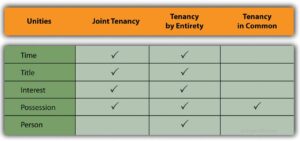
Joint tenancy is an estate in land owned by two or more persons. It is distinguished chiefly by the right of survivorship. If two people own land as joint tenants, then either becomes the sole owner when the other dies. For land to be owned jointly, four unities must coexist:

  1. Unity of time. The interests of the joint owners must begin at the same time.
  2. Unity of title. The joint tenants must acquire their title in the same conveyance—that is, the same will or deed.
  3. Unity of interest. Each owner must have the same interest in the property; for example, one may not hold a life estate and the other the remainder interest.
  4. Unity of possession. All parties must have an equal right to possession of the property (see Figure 12.1 “Forms of Ownership and Unities”).

Figure 12.1 Forms of Ownership and Unities

Suppose a woman owns some property and upon marriage wishes to own it jointly with her husband. She deeds it to herself and her husband “as joint tenants and not tenants in common.” Strictly speaking, the common law would deny that the resulting form of ownership was joint because the unities of title and time were missing. The wife owned the property first and originally acquired title under a different conveyance. But the modern view in most states is that an owner may convey directly to herself and another in order to create a joint estate.

When one or more of the unities is destroyed, however, the joint tenancy lapses. Fritz and Gary own a farm as joint tenants. Fritz decides to sell his interest to Jesse (or, because Fritz has gone bankrupt, the sheriff auctions off his interest at a foreclosure sale). Jesse and Gary would hold as tenants in common and not as joint tenants. Suppose Fritz had made out his will, leaving his interest in the farm to Reuben. On Fritz’s death, would the unities be destroyed, leaving Gary and Reuben as tenants in common? No, because Gary, as joint tenant, would own the entire farm on Fritz’s death, leaving nothing behind for Reuben to inherit.

Tenancy by the Entirety

About half the states permit husbands and wives to hold property as tenants by the entirety. This form of ownership is similar to joint tenancy, except that it is restricted to husbands and wives. This is sometimes described as the unity of person. In most of the states permitting tenancy by the entirety, acquisition by husband and wife of property as joint tenants automatically becomes a tenancy by the entirety. The fundamental importance of tenancy by the entirety is that neither spouse individually can terminate it; only a joint decision to do so will be effective. One spouse alone cannot sell or lease an interest in such property without consent of the other, and in many states a creditor of one spouse cannot seize the individual’s separate interest in the property, because the interest is indivisible.

Tenancy in Common

Two or more people can hold property as tenants in common when the unity of possession is present, that is, when each is entitled to occupy the property. None of the other unities—of time, title, or interest—is necessary, though their existence does not impair the common ownership. Note that the tenants in common do not own a specific portion of the real estate; each has an undivided share in the whole, and each is entitled to occupy the whole estate. One tenant in common may sell, lease, or mortgage his undivided interest. When a tenant in common dies, his interest in the property passes to his heirs, not to the surviving tenants in common.

Because tenancy in common does not require a unity of interest, it has become a popular form of “mingling,” by which unrelated people pool their resources to purchase a home. If they were joint tenants, each would be entitled to an equal share in the home, regardless of how much each contributed, and the survivor would become sole owner when the other owner dies. But with a tenancy-in-common arrangement, each can own a share in proportion to the amount invested.

Community Property

In ten states—Alaska, Arizona, California, Idaho, Louisiana, Nevada, New Mexico, Texas, Washington, and Wisconsin—property acquired during a marriage is said to be community property. There are differences among these states, but the general theory is that with certain exceptions, each spouse has an undivided equal interest in property acquired while the husband and wife are married to each other. The major exception is for property acquired by gift or inheritance during the marriage. (By definition, property owned by either spouse before the marriage is not community property.) Property acquired by gift of inheritance or owned before the marriage is known as separate property. Community property states recognize other forms of ownership; specifically, husbands and wives may hold property as joint tenants, permitting the survivor to own the whole.

The consequence of community property laws is that either the husband or the wife may manage the community property, borrow against it, and dispose of community personal property. Community real estate may only be sold or encumbered by both jointly. Each spouse may bequeath only half the community property in his or her will. In the absence of a will, the one-half property interest will pass in accordance with the laws of intestate succession. If the couple divorces, the states generally provide for an equal or near-equal division of the community property, although a few permit the court in its discretion to divide in a different proportion.

Condominiums

In popular parlance, a condominium is a kind of apartment building, but that is not its technical legal meaning. Condominium is a form of ownership, not a form of structure, and it can even apply to space—for example, to parking spaces in a garage. The word condominium means joint ownership or control, and it has long been used whenever land has been particularly scarce or expensive. Condominiums were popular in ancient Rome (especially near the Forum) and in the walled cities of medieval Europe.

In its modern usage, condominium refers to a form of housing involving two elements of ownership. The first is the living space itself, which may be held in common, in joint tenancy, or in any other form of ownership. The second is the common space in the building, including the roof, land under the structure, hallways, swimming pool, and the like. The common space is held by all purchasers as tenants in common. The living space may not be sold apart from the interest in the common space.

Two documents are necessary in a condominium sale—the master deed and the bylaws. The master deed (1) describes the condominium units, the common areas, and any restrictions that apply to them; (2) establishes the unit owner’s interest in the common area, his number of votes at owners’ association meetings, and his share of maintenance and operating expenses (sometimes unit owners have equal shares, and sometimes their share is determined by computing the ratio of living area or market price or original price of a single unit to the whole); and (3) creates a board of directors to administer the affairs of the whole condominium. The bylaws usually establish the owners’ association, set out voting procedures, list the powers and duties of the officers, and state the obligations of the owners for the use of the units and the common areas.

Cooperatives

Another popular form of owning living quarters with common areas is the cooperative. Unlike the person who lives in a condominium, the tenant of a cooperative does not own a particular unit. Instead, he owns a share of the entire building. Since the building is usually owned by a corporation (a cooperative corporation, hence the name), this means that the tenant owns stock in the corporation. A tenant occupies a unit under a lease from the corporation. Together, the lease and stock in the building corporation are considered personal, not real, property.

In a condominium, an owner of a unit who defaults in paying monthly mortgage bills can face foreclosure on the unit, but neighbors in the building suffer no direct financial impact, except that the defaulter probably has not paid monthly maintenance charges either. In a cooperative, however, a tenant who fails to pay monthly charges can jeopardize the entire building, because the mortgage is on the building as a whole; consequently, the others will be required to make good the payments or face foreclosure.

Time-Shares

A time-share is an arrangement by which several people can own the same property while being entitled to occupy the premises exclusively at different times on a recurring basis. In the typical vacation property, each owner has the exclusive right to use the apartment unit or cottage for a specified period of time each year—for example, Mr. and Mrs. Smith may have possession from December 15 through December 22, Mr. and Mrs. Jones from December 23 through December 30, and so on. The property is usually owned as a condominium but need not be. The sharers may own the property in fee simple, hold a joint lease, or even belong to a vacation club that sells time in the unit.

Time-share resorts have become popular in recent years. But the lure of big money has brought unscrupulous contractors and salespersons into the market. Sales practices can be unusually coercive, and as a result, most states have sets of laws specifically to regulate time-share sales. Almost all states provide a cooling-off period, or rescission period; these periods vary from state to state and provide a window where buyers can change their minds without forfeiting payments or deposits already made.

                                Key Takeaway

Property is sometimes owned by one person or one entity, but more often two or more persons will share in the ownership. Various forms of joint ownership are possible, including joint tenancies, tenancy by the entirety, and tenancy in common. Married persons should be aware of whether the state they live in is a community property state; if it is, the spouse will take some interest in any property acquired during the marriage. Beyond traditional landholdings, modern real estate ownership may include interests in condominiums, cooperatives, or time-shares.

                                     Exercises

  1. Miguel and Maria Ramirez own property in Albuquerque, New Mexico, as tenants by the entirety. Miguel is a named defendant in a lawsuit that alleges defamation, and an award is made for $245,000 against Miguel. The property he owns with Maria is worth $320,000 and is owned free of any mortgage interest. To what extent can the successful plaintiff recover damages by forcing a sale of the property?
  2. Miguel and Maria Ramirez own property in Albuquerque, New Mexico, as tenants by the entirety. They divorce. At the time of the divorce, there are no new deeds signed or recorded. Are they now tenants in common or joint tenants?
Leave a comment

Understanding the Rent Control Act in the Philippines

Facebooktwitterredditpinterestlinkedinmail

For anyone renting or planning to rent a property in the Philippines, understanding the Rent Control Act is crucial. This law aims to protect tenants from unreasonable rent increases while ensuring landlords can still fairly profit from their properties. Let’s break down the key aspects of this act to help both tenants and landlords navigate their rights and responsibilities.


What is the Rent Control Act? 
The Rent Control Act of the Philippines refers to Republic Act No. 9653, also known as the “Rent Control Act of 2009”, as extended by subsequent regulations. It governs rental pricing, increases, and disputes for residential units within specific rent ranges, particularly in urban areas.

The law primarily covers: 

– Residential units with a monthly rent of up to ₱10,000 in Metro Manila. 

– Units with a monthly rent of up to ₱5,000 in other cities and municipalities. 

 Key Provisions 

1. Limit on Rent Increases 

Landlords cannot increase rent by more than 7% annually for covered properties, provided the same tenant occupies the unit.

2. Protection Against Eviction 

  Tenants cannot be evicted except under specific circumstances, such as:

   -Non-payment of rent for three consecutive months. 

   -Subleasing without the landlord’s consent. 

   – The landlord needing the property for personal use or renovations. 

3. Advance Payments and Deposits 

   – Landlords are allowed to collect up to one-month advance rent and two months’ deposit. 

   – Deposits must be returned to the tenant upon moving out, minus any deductions for damages. 

4. Rental Contracts  Both tenants and landlords are encouraged to have a written rental agreement specifying the terms and conditions of the lease, including rent, duration, and responsibilities.

Who Benefits from the Rent Control Act? 

The act primarily benefits low- to middle-income families, students, and employees who rent affordable housing. It ensures they are not priced out of their homes due to sudden, excessive rent increases. 

What the Rent Control Act Doesn’t Cover 

The Rent Control Act does not apply to: 

– Commercial properties. 

– Residential units rented out for over ₱10,000 per month in Metro Manila and ₱5,000 per month in other areas. 

– New leases not covered by existing agreements.

Recent Updates 

While RA 9653 officially expired, the Philippine government often extends similar provisions to address housing affordability. As of today, tenants and landlords should stay updated with the latest housing and rental policies implemented by the Housing and Land Use Regulatory Board (HLURB) or other government bodies. 

 Tips for Tenants 

– Always sign a written agreement and understand its terms before moving in. 

– Keep records of your payments and communications with your landlord. 

– Report any violations of the Rent Control Act to local housing authorities or barangay offices. 

 Tips for Landlords 

– Familiarize yourself with the Rent Control Act to avoid legal disputes. 

– Clearly communicate rental terms and increases with tenants in writing. 

– Maintain the property to ensure tenants receive value for their rent. 

Final Thoughts 

The Rent Control Act is a critical safeguard for renters and a guide for landlords in managing rental properties. Whether you’re a tenant or landlord, understanding this law can foster a fair and harmonious rental relationship. 

Stay informed about changes to rental policies and consult legal or housing experts for specific concerns. After all, a well-informed rental community benefits everyone.

Leave a comment