All posts by jennica javier

The Subdivision and Condominium Buyers’ Protective Decree

Facebooktwitterredditpinterestlinkedinmail

The Subdivision and Condominium Buyers’ Protective Decree

Presidential Decree No. 957 or the Subdivision and Condominium Buyers’ Protective Decree was implemented in order to protect subdivision and condominium buyers from developers, operators, and even sellers from reneging on their representations or obligations towards them.

P.D. 957 addresses some of the common inquiries pertaining to the purchase of subdivision and condominium units below:

What are the requirements that real estate developers need to comply prior to the construction and sale of the project?

Under the law, the owner, real estate developer, or dealer is required to submit a plan and secure a development permit from the Department of Human Settlements and Urban Development (“DHSUD”) prior to the construction and establishment of condominium units or subdivisions. Next, it is important to note that after obtaining the approved plan and permit, the owner, real estate developer, or dealer is mandated to register their project and obtain a license to sell (“LTS”) within two (2) weeks from the registration from the same government agency.

What are the obligations of the real estate developers to the buyers with regard to completion of the project and delivery of title of the property?

With respect to the timeline for the project completion, pursuant to Section 20 of P.D. 957, real estate developers are given one (1) year from the date of the issuance of the license for the subdivision or condominium project, or such other period of time as may be fixed by DHSUD to construct and provide the facilities, improvements, infrastructures, and other forms of development, including water supply and lighting facilities, which it/he offered and indicated in the approved subdivision or condominium plans, brochures, prospectus, printed matters, letters or in any form of advertisement.

With respect to the delivery of the title, according to Section 25 of P.D. 957, the real estate developer is obliged to deliver the title of the subdivision lot or condominium unit to the buyer upon full payment of the lot or unit. In compliance with said obligation, no fees, except those for the registration of the deed of sale in the Registry of Deeds, shall be collected by the real estate developer for the issuance of the title.

What happens to the real estate developer if it fails to fulfill with the aforesaid obligations?

The DHSUD may impose an administrative fine not exceeding ten thousand pesos (PhP10,000.00) for violations of the provisions of this Decree or of any rule or regulation as may be applicable. Furthemore, under Section 39 of P.D. 957, the real estate developer shall be punished by a fine of not more than twenty thousand (P20,000.00) pesos and/or imprisonment of not more than ten years.

Leave a comment

Capacity to Buy or Sell Property

Facebooktwitterredditpinterestlinkedinmail

Capacity to Buy or Sell in the Philippine Civil Law (Contract of Sale)

The capacity to buy or sell is a fundamental concept under the Contract of Sale, governed by the provisions of the Civil Code of the Philippines. The law meticulously defines the qualifications and restrictions concerning parties’ ability to enter into contracts of sale, ensuring that transactions are lawful and free from defects due to incapacity.

1. General Rule on Capacity

Under Article 1327 of the Civil Code, all persons who can bind themselves in a contract have the capacity to buy or sell. This includes:

  • Persons who are of legal age (18 years or older).
  • Persons who are not otherwise disqualified by law.
  • Persons who have the full use of their reason and judgment.

2. Special Rules on Capacity

A. Minors and Incapacitated Persons

Minors, insane or demented persons, and deaf-mutes who do not know how to write are generally considered incapacitated to buy or sell under the general principles of contracts.

However, exceptions exist:

  1. Necessaries: Under Article 1489, minors and incapacitated persons may validly purchase necessaries (e.g., food, clothing, medicine, education) for themselves or their families. The contract remains valid but subject to fair and reasonable terms.
  2. Ratification upon Reaching Majority: A sale entered into by a minor may be ratified upon reaching the age of majority, making it enforceable.
  3. Contracts by Guardians: Guardians may sell the property of minors or incapacitated persons with court approval to protect their interests.

B. Spouses

Under Article 1490, the law imposes restrictions on spouses’ capacity to buy or sell:

  • No Sale Between Spouses: Spouses are prohibited from selling property to each other, except when:
    1. A judicial separation of property exists.
    2. One spouse is selling property as a legal guardian or administrator to the other spouse (e.g., under a guardianship order or judicial authority).

This prohibition is aimed at preventing fraudulent transfers that could prejudice creditors or circumvent inheritance laws.


C. Persons Prohibited by Law

Certain individuals are explicitly prohibited from purchasing under Article 1491 of the Civil Code:

  1. Public Officers and Employees: Public officers or employees are prohibited from purchasing property that is under their administration, custody, or disposal during their tenure.
  2. Executors, Administrators, and Guardians: These persons cannot purchase property entrusted to their care or administration unless explicitly allowed by law.
  3. Judges, Lawyers, and Others: Judges, clerks of court, and lawyers cannot purchase property involved in litigation in which they are involved by virtue of their profession or office.
  4. Others Specifically Disqualified:
    • Officers of corporations or partnerships cannot purchase corporate property when acting on behalf of the corporation.

These provisions are grounded in public policy to avoid conflicts of interest, abuse of position, and undue influence.

3. Effects of Incapacity

  • Voidable Contracts: Contracts entered into by incapacitated persons are generally voidable unless they involve necessaries or are ratified.
  • Void Contracts: A sale made in violation of Article 1491 (e.g., sale by a public officer of government property under their custody) is null and void.
  • Restitution: If a contract is voided due to incapacity, the incapacitated party is generally required to restore what they received, if possible, except in cases where they have consumed necessaries.

4. Capacity to Buy or Sell in Special Circumstance

A. Aliens       

  • Aliens are generally allowed to purchase and sell property in the Philippines, except when restricted by law or the Constitution. For instance, under the 1987 Constitution, aliens are prohibited from owning land, but they may own condominium units or buildings.

B. Corporations

  • Corporations may buy and sell property provided it is within their corporate powers as defined in their Articles of Incorporation. However, certain corporations, like educational institutions, may face restrictions under the Constitution and laws concerning land ownership.

5. Judicial Remedies

If a person believes a contract of sale was executed in violation of capacity rules, the following remedies are available:

  • Action for Annulment: File a case to annul the contract based on incapacity.
  • Action for Restitution: Seek restitution of property or funds exchanged.
  • Action for Damages: Claim damages resulting from the unlawful transaction.

6. Case Law on Capacity to Buy or Sell

Philippine jurisprudence has consistently upheld the provisions of the Civil Code on capacity to buy or sell:

  1. Heirs of Guido v. Court of Appeals (G.R. No. 118151, February 8, 1999): Clarified the prohibition on sales between spouses as protecting the sanctity of family relations and inheritance rights.
  2. Agpalo v. Rosales (G.R. No. 152860, June 25, 2008): Reinforced the void nature of contracts entered into by incapacitated persons without proper ratification.
  3. Republic v. Sandiganbayan (G.R. Nos. 104768-69, July 21, 2003): Highlighted the prohibition on public officers purchasing government property under their care.

Conclusion

The capacity to buy or sell under the Civil Code ensures fairness, protects vulnerable parties, and prevents abuse in contractual transactions. These rules must be carefully observed to uphold the validity and enforceability of contracts of sale in the Philippines.

Leave a comment

Legal Lease: The Things You Need To Know In Leasing Real Property

Facebooktwitterredditpinterestlinkedinmail

Legal Lease: The Things You Need To Know In Leasing Real Property

In our last article, we shared the steps on how to become a homeowner. While owning a property is a lifelong dream for most of us, the steep cost of living makes it more difficult for others to save money for their own houses or business spaces. There is also a growing number of digital nomads, who prefer transient arrangements compatible to the ever-changing demands of business.  As a practical solution, many resort to leasing properties for residential or commercial use. Despite this common practice, the legal knowledge of many Filipino and foreign nationals residing in the Philippines on leasing contracts is often limited to rental costs and periods of lease. To many lessees and even lessors, the terms and conditions are nothing but legal mumbo jumbo. Given its significance, a basic understanding of the laws on leases is a must.

Definition

As legally defined, lease is a contract whereby the lessor temporarily allows another person to use his property in consideration of rental payments.  The parties are free to agree on the terms and conditions of the lease contract, unless these terms and conditions are contrary to law, morals, good customs, public order, or public policy.

Ultimately, a lease contract is the law between the parties, binding them with respective rights and obligations enforceable under the law. Thus, a lease contract must be well-drafted so as to reflect the intent of the parties, and to foster trust, transparency, and security in long-term and even short-term lease arrangement.

Here are some key stipulations you must know about in leasing real properties.

Period

If the period of lease was fixed for a definite period, the effectivity of the lease contract ends on the date agreed upon; the lessor is not required to demand for the lessee to return the possession of the property to him or her. 

If the parties fail to fix the period of lease, in case of urban lands, the payment of rent determines the period of lease. If rent is paid annually, the lease period is one year. If the rent is paid monthly, the lease period is one month. The same rule applies if the rent is paid weekly or daily.

Notice to Vacate

As a rule, a notice or demand to vacate is not needed to terminate a lease contract. Upon the expiration of the lease contract, the tenant who continues to occupy the property becomes a deforciant, or someone who is unlawfully withholding the property from the lessor. Upon a demand to vacate, the lessor may file a case to lawfully eject the lessee from the premises.

However, where the lessor consented to the occupation of the leased premises for fifteen (15) days even after the expiration of contract, the lease is deemed renewed with a period based on the frequency or period of payment and whose other terms are revived. If, however, the lessor sent a notice to vacate after the expiration of lease, such notice shall terminate the implied renewal and the lessee must vacate the premises.

In a tricky situation where the lessor sold the real property to another without the lessee’s knowledge, the purchaser may terminate the lease except when there is a stipulation contrary to the contract of sale between the lessor and the purchaser, or the purchaser knows of the existence of lease. Further, a lease of real property not recorded in the Registry of Deeds is not binding upon third persons, which may include a purchaser buying the real property in good faith.

Rent

While lessors are allowed to increase rent, this is not without limit for certain properties.

For lessors of residential units in the National Capital Region or other highly urbanized cities with a maximum rent of P10,000.00 and all residential units in all other areas with a maximum rent of P5,000.00, they can only increase rent annually, it shall shall not exceed  seven percent (7%), if that the leased premises is occupied by the same lessee. The lessor cannot demand more than one (1) month advance rent, or two (2) months deposit.

To reiterate, the Rent Control Act only covers residential units within the abovementioned rent threshold.

Residential units with rent above the threshold and commercial units, therefore, are not regulated by the said law. However, this does not give them a blanket authority to unreasonably increase rent as courts can intervene in fixing the rent to uphold fairness and equity.

Subleasing

The lessee may sublease the leased premises even without the permission of the lessor, if there is no express prohibition in the contract. Nonetheless, the lessor and the lessee are still bound by the rights and obligations in their lease contract. The sublessee, in turn, is subsidiarily liable to the lessor for any rent due from the lessee but not beyond the amount fixed in the sublease agreement.Moreover, the sublessee does not have any direct action against the lessee.

So, while subleasing is allowed, sublessees must still take note of potential risks and liabilities of entering such an arrangement.

Rights of Heirs

Finally, the rights and obligations of the parties in a lease contract may be transmitted to the heirs of the parties  unless the rights and obligations of the parties are not transmissible by its nature, by stipulation, or by provision of law.

Legal Proof

As the ink dries on the lease contract, its implications ripple through time. Lessors and lessees are encouraged to future-proof their lease contracts to ensure a mutually beneficial arrangement. AJA Law is here to provide the much needed support to maneuver the intricacies of leasing and find solutions to controversies arising therefrom.

Leave a comment

Contract To Sell Vs. Contract Of Sell

Facebooktwitterredditpinterestlinkedinmail

Contract of Sale vs. Contract to Sell

The distinction between a Contract of Sale and a Contract to Sell is fundamental in Philippine Civil Law, specifically under the law on obligations and contracts. These two agreements, while closely related and often confused, have distinct legal implications, especially concerning the transfer of ownership and remedies available in case of breach. Below is a comprehensive analysis:

1. Definition and Key Features

Contract of Sale

  • Nature: A principal contract wherein one party (the seller) obligates himself to transfer ownership of and deliver a determinate thing to another party (the buyer), who, in turn, obligates himself to pay a price certain in money or its equivalent.
  • Ownership Transfer: Ownership is transferred to the buyer upon the perfection of the contract (or upon delivery, if agreed upon as a condition).
  • Risk of Loss: The risk of loss is immediately borne by the buyer once ownership has passed.
  • Contract to Sell

    • Nature: A preparatory contract where the seller reserves ownership of the property until the buyer fulfills a suspensive condition (e.g., full payment of the purchase price).
    • Ownership Transfer: Ownership is not transferred until the suspensive condition is met.
    • Risk of Loss: The seller retains the risk of loss since ownership remains with him until the condition is fulfilled
  • 2. Legal Basis

    Contract of Sale

    • Article 1458, Civil Code of the Philippines:

      “By the contract of sale one of the contracting parties obligates himself to transfer the ownership of and to deliver a determinate thing, and the other to pay therefor a price certain in money or its equivalent.”

    Contract to Sell

    • Not explicitly defined in the Civil Code but recognized by jurisprudence as a valid contract. The courts characterize it as distinct from a Contract of Sale due to the conditional nature of the transfer of ownership.
  • 3. Differences

    Aspect Contract of Sale Contract to Sell
    Nature Consummated contract upon delivery and payment of price. Conditional contract dependent on the fulfillment of a condition.
    Ownership Transfer Ownership passes upon perfection (or delivery). Ownership passes only upon fulfillment of a suspensive condition.
    Risk of Loss Risk transfers to the buyer upon perfection (or delivery). Risk remains with the seller until the suspensive condition is fulfilled.
    Remedy for Breach Specific performance or rescission under Article 1191. No rescission; mere non-fulfillment of the condition prevents the transfer of ownership.
    Reservation of Ownership Not applicable; ownership is not reserved. Ownership is expressly reserved by the seller.

4. Essential Elements

Contract of Sale

  1. Consent: Mutual agreement between parties.
  2. Object: A determinate thing or specific good.
  3. Price: Must be certain in money or its equivalent.

Contract to Sell

  1. Consent: Agreement on the conditional transfer of ownership.
  2. Object: A specific property to be sold in the future.
  3. Condition: Fulfillment of a suspensive condition (e.g., full payment of the price).

5. Legal and Jurisprudential Implications

Ownership Transfer

  • In a Contract of Sale, the seller cannot recover the property once delivered, unless there is a legal ground for rescission.
  • In a Contract to Sell, failure to fulfill the condition prevents ownership transfer, and the seller can retain the property without needing rescission proceedings.

Breach of Contract

  • In a Contract of Sale, breach may give rise to rescission under Article 1191 or damages under Articles 1170-1174.
  • In a Contract to Sell, failure to fulfill the condition is not considered a breach; rather, it results in the automatic non-transfer of ownership.

Risk of Loss

  • Under Article 1262, loss or deterioration of the thing sold is borne by the buyer if ownership has already passed.
  • In a Contract to Sell, the seller bears the risk as ownership remains with him.

Remedies for the Seller

  • In a Contract of Sale, the seller may:
    1. Demand payment of the price.
    2. Rescind the sale for breach.
  • In a Contract to Sell, the seller need not rescind because the failure to fulfill the suspensive condition automatically negates the obligation to sell.

6. Jurisprudence

Philippine courts have repeatedly clarified the distinction between these two contracts:

Heirs of Felipe Lazo v. Spouses Lazo (G.R. No. 176545)

  • The Court held that a Contract to Sell is a conditional sale where ownership is retained by the seller until the buyer pays in full. The non-fulfillment of the condition means no sale arises.

Coronel v. CA (G.R. No. 103577)

  • The Court distinguished a Contract of Sale, where ownership transfers upon delivery, from a Contract to Sell, where ownership remains with the seller until payment of the full price.

Sps. Santos v. CA (G.R. No. 102428)

  • The Court emphasized that in a Contract to Sell, the failure to pay the purchase price is not a breach but merely prevents the sale from being perfected.

7. Practical Application

  • Contract of Sale is often used in cash sales or transactions where payment is immediate or installment arrangements are accompanied by delivery of ownership.
  • Contract to Sell is preferred in real estate transactions where full payment is required before the transfer of title to safeguard the seller’s interest.

Conclusion

Understanding the distinction between a Contract of Sale and a Contract to Sell is crucial for both buyers and sellers. It affects ownership, risk allocation, and available remedies. Legal practitioners must carefully draft contracts to ensure

Leave a comment

The Condominium Concept

Facebooktwitterredditpinterestlinkedinmail

            The Condominium Concept                                                                

Unit and the Unit Owner: The “unit” is that portion or part of the condominium property which is subject to exclusive ownership. The boundaries and the description of each unit must be specifically set forth in the declaration creating the condominium, and ownership of a unit entitles the owner to its exclusive use. Once the real property has been submitted to condominium status, all the individual units become separate parcels of real property. The use of the unit must be consistent with the regulations and restrictions in the declaration of condominium, and the association has an irrevocable right of access to each unit when it is necessary to maintain, repair, or replace a portion of the common elements or any portion of the unit to be maintained by the association pursuant to the declaration of condominium. The association also has the right of access to each unit when it is necessary to make emergency repairs in a unit to prevent further damage to common elements or to another unit.

Common elements:
The portion of the condominium property jointly
owned by all of the owners is defined as “common elements”
and itincludes all of the condominium property that is
not located within the defined boundaries of the
individual units. The property legally described
in a declaration of condominium must be one of
two kinds—it must be a “unit” specifically described
with a percentage of common element
ownership assigned to it, or it will be common
elements and jointly owned by all of the unit
owners. No portion of the common elements is
subject to exclusive ownership for so long as it
remains a part of the condominium.
The common elements are, however, subject to
exclusive use by a particular unit or units to the
exclusion of others if the declaration of condominium
permits it. Common elements set aside
for exclusive use by the declaration are known
as “limited common elements” and examples
include balconies, patios, storage lockers, and
assigned parking spaces. Except for these limited
common elements, all other portions of the
common elements are for use by all of the unit


Leave a comment

Conjugal Property Dispute After Separation in the Philippines

Facebooktwitterredditpinterestlinkedinmail

Below is an extensive discussion of conjugal property disputes after separation in the Philippines, focusing on the statutory provisions, legal principles, and practical considerations. This article covers the types of property regimes, distinctions between de facto and legal separation, the process of dividing conjugal assets, and common remedies and actions available to spouses.

1. Legal Framework in the Philippines

  1. Family Code of the Philippines (Executive Order No. 209, as amended):
    • Governs marriages contracted after August 3, 1988.
    • Establishes the default property regime (Absolute Community of Property) if there is no prenuptial agreement.
  2. Civil Code of the Philippines:
    • Governs marriages celebrated before the effectivity of the Family Code (i.e., prior to August 3, 1988).
    • Conjugal Partnership of Gains was the usual default regime before the Family Code took effect, although some couples still choose it by way of a marriage settlement.
  3. Other Relevant Legislation and Jurisprudence:
    • Supreme Court decisions interpret ambiguous provisions and guide how courts resolve specific controversies.
    • Rules of Court govern procedure for judicial actions to settle property disputes.

      2. Property Regimes Under Philippine Law

      In the Philippine legal system, spouses may agree upon a property regime before marriage through a prenuptial agreement (also called a marriage settlement). In the absence of such an agreement, the default regimes apply depending on the date of marriage:

        1. Conjugal Partnership of Gains (CPG)
          • Default regime for marriages celebrated before the Family Code took effect, or if the spouses expressly choose it in a prenuptial agreement under the Family Code.
          • Each spouse generally retains ownership of property acquired before the marriage (referred to as “capital property”). Only the income, fruits, and properties acquired during the marriage (the “conjugal partnership of gains”) form the common fund.
          • This common fund is divided upon dissolution of the marriage or termination of the partnership.
        2. Complete Separation of Property
          • The spouses may stipulate in their prenuptial agreement to adopt complete separation of property.
          • Each spouse owns, disposes of, and manages their property independently.
          • This is not the default regime unless explicitly chosen.

        Because many Filipinos still colloquially refer to “conjugal property” even under an Absolute Community of Property regime, the term “conjugal” is often used informally to mean any property that is jointly owned by the spouses. In strict legal terms, “conjugal partnership property” specifically applies to the Conjugal Partnership of Gains regime.

      Absolute Community of Property (ACP)

      • Default regime for marriages celebrated under the Family Code (post–August 3, 1988) unless a prenuptial agreement states otherwise.
      • Under ACP, all property owned by the spouses at the time of the marriage and acquired thereafter generally becomes part of a single mass of property.
      • Exceptions include property acquired by gratuitous title (e.g., inheritance, donation), personal properties such as clothes or personal effects, and those excluded by law.

        3. Separation in Fact vs. Legal Separation

        3.1 Separation in Fact

        • Definition: Spouses live apart without obtaining a judicial decree. They are not legally separated, annulled, or divorced (divorce is generally not recognized in the Philippines, except under limited circumstances, e.g., for Muslims under PD 1083 or in cases of foreign divorce recognized under certain conditions).
        • Effect on Property:
          • Mere separation in fact does not dissolve the property regime.
          • The spouses remain bound by their property relations (whether ACP or CPG).
          • Each spouse still has a fiduciary duty to preserve the marital property. Transactions disposing of or encumbering conjugal/ community property generally require consent of both spouses (subject to exceptions in the law).

            3.2 Legal Separation

            • Definition: A decree of legal separation is granted by a court when certain grounds are proven (e.g., repeated physical violence, moral pressure to change religious or political affiliation, attempt against the spouse’s life, etc.).
            • Effect on Property:
              • A decree of legal separation typically results in separation of property.
              • The court will order the liquidation of the existing ACP or CPG, dividing the net assets as mandated by law.
              • Future acquisitions become exclusive property of each spouse.

            Important Note: Legal separation does not terminate the marital bond; it only affects property relations and the right to cohabitation. Annulment (or declaration of nullity of marriage) is an entirely different procedure that can result in the dissolution of the marriage bond itself.

            4. Dissolution or Termination of the Property Regime

            A conjugal property regime (whether ACP or CPG) can be dissolved in any of the following situations:

            1. Death of either spouse
            2. Declaration of nullity or annulment of the marriage
            3. Legal separation (through a final court decree)
            4. Judicial separation of property (granted under certain grounds, e.g., failure of one spouse to comply with marital obligations, abandonment, loss of parental authority)
            5. Court-approved voluntary dissolution of property under extraordinary circumstances

            Once the regime is dissolved, the next legal step is liquidation—identifying which properties belong to the spouses separately and which belong to the common fund—and partitioning these assets accordingly.

            5. Identifying Conjugal Property

            Key guidelines for determining conjugal (or community) property include:

            1. Property Acquired During Marriage
              • Under ACP: Nearly all property acquired by either spouse during the marriage is part of the community property.
              • Under CPG: The “conjugal partnership” generally comprises the fruits, products, and income from the spouses’ separate or capital properties, plus any property acquired with such income.
            2. Exclusions
              • Property acquired prior to the marriage (where CPG applies).
              • Property inherited or donated to one spouse (exclusion applies under both ACP and CPG, unless expressly provided otherwise by the donor/testator).
              • Personal belongings (clothes, personal effects).
              • Property purchased through exclusive funds of one spouse (subject to proof).
            3. Proof of Exclusive Ownership
              • Spouses often dispute whether an item is “conjugal” or “separate.” Documentary evidence (e.g., deeds of sale, bank records, statement of account) is crucial.
              • Courts typically err on the side of presuming property acquired during marriage to be conjugal/ community unless proven otherwise.
Leave a comment

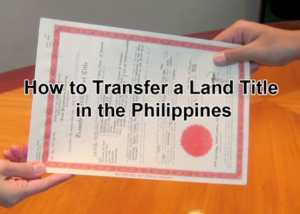
How to Transfer Land Title in the Philippines 2025 

Facebooktwitterredditpinterestlinkedinmail

How to Transfer Land Title in the Philippines 2025


In the Philippines, a land title is the ultimate proof of property ownership under the Torrens Title System, which records the transfer of ownership from one owner to the next. You may not usually need to know the process unless you are a real estate professional, a seller, or a buyer—but once you buy or sell property, understanding how to transfer a land title becomes essential. During a property transaction, all parties—the seller, listing broker, buyer, and buyer’s broker—should clearly agree from the beginning on who will handle the title transfer. If you are the buyer, it’s in your best interest to understand the steps for transferring the land title to your name. You can do the process yourself if you have the time and patience, or you may hire a lawyer, licensed real estate broker, or a title transfer company for a service fee, which varies depending on the property location. For your reference and guidance, here are the:

4 Steps on How to Transfer Land Title in the Philippines Note that we refer to it as a land title transfer procedure but the same goes when transferring title for a condominium or other properties.

Transfer of Title Requirements Philippines.

1. Deed of Conveyance – whether it is a Deed of Absolute Sale (DOAS), Extrajudicial Settlement of Estate with Sale (EJS with Sale), Deed of Donation, etc. Prepare 8 copies.

– For sales transactions, prepare an Acknowledgement Receipt of the amount received by the seller. If the seller is a real estate developer or a real estate dealer who is habitually engaged in real estate, the seller can issue an Official Receipt.

– Make sure the deed indicates the unique Tax Identification Number (TIN) numbers of the parties involved. Important: the spelling of the names on the deed of conveyance, the name on the Bureau of Internal Revenue (BIR) TIN, and on the identification documents should be the same; the signature on the deed of conveyance and on the IDs should be the same.

– Both the Deed of Conveyance and the Acknowledgement Receipt must be notarized.

– Why prepare 8 copies? Here’s the distribution breakdown:

– Notary Public – Seller – Seller’s Licensed Real Estate Broker

– Buyer

– Buyer’s Licensed Real Estate Broker

– Copy for submission to the various government agencies (Bureau of Internal Revenue, LGU Treasurer’s Office, Registry of Deeds, LGU Assessor’s Office) – Copy for the Condominium Corporation or Homeowner’s Association

2. Photocopies of IDs of all signatories in the deed; all photocopies must have 3 signatures of the owner of the ID; IDs are called “competent evidence of identity” and are defined as a “current identification document issued by an official agency bearing the photograph and signature of the individual”. Examples: Valid Passport, Valid Driver’s License, Valid license cards issued by the Professional Regulations Commission, etc. Important: Do not use expired IDs.Official Receipt of the Notary Public for the notarization of the deed.

3. Official Receipt of the Notary Public for the notarization of the deed.

4. Certified True Copy of the Title (Get 3 copies.) You will get this from the Registry of Deeds that has jurisdiction over the property.

5. Certified True copy of the latest Tax Declaration. When you request for the certified true copies of the latest Tax Declaration indicate that the request for the copies are for “BIR Purposes”. Please take note that there are separate tax declarations for the land and for the improvement (ex. house, building). The Tax Declaration is issued by the Assessor’s Office of the city or municipality where the property is located.

6. Tax Clearance – Issued by the Office of the Treasurer of the city or municipality. This certifies that the Real Property Taxes for the property, both the land and improvements, have been paid. Requirements to get a Tax Clearance: – Latest Tax Declaration – Latest Official Receipts of Real Property Tax payments – Previous Tax Clearance (if any) – Notarized or Apostilled SPA and valid ID if the requesting party is not the registered owner. Some LGUs allow just a simple authorization letter from the owner.

7. Clearance from the Homeowners Association (HOA) if the property, whether lot only, house and lot, lot with building, is located inside a subdivision or Management Certificate if the property is a condominium unit. Both the HOA Clearance and Management Certificate prove that the seller has settled all HOA/condo dues for the year. The certificate also indicates if the property has been leased. Note: Have this certificate notarized.

8. Marriage certificate (for married sellers and buyers)

9. Birth certificate (only when applicable). This is needed in cases of Deed of Donation to prove the relationship between donor and donee or Extra-Judicial Settlements to prove the relationship between decedent and heirs.

10. Certificate of No Marriage (Cenomar) (only when applicable). Needed if seller or buyer is single. Please take note that the Cenomar is valid only for six (6) months from its issuance by the Philippine Statistics Authority (PSA)

11. For lots-only sale: Certificate of No Improvement. Secure this from the Assessor’s Office of the city or municipality

12. 3” x 5” color photos of the property frontage or facade – Land and House – Photo showing the front outside of the house including the house number. – Condominium – Photo showing the building with the building name visible. Photo of the unit door with the door number visible.

13. Location map – just print a Google Map pertaining to the property.

14. Owner’s Duplicate Copy of the Title – Transfer Certificate of Title (TCT) – for land-only or house and lot or lot with improvement – Condominium Certificate of Title (CCT) – for a residential condominium, office condominium, or parking unit 15. Special Power of Attorney to Process the Title Transfer – if someone else shall process your title transfer. This SPA shall be required by the BIR, LGU Treasurer’s Office, Registry of Deeds, and LGU Assessor’s Office. Important: It should be signed by the SELLER.

Leave a comment